
The AC Repair vs Replace Question Every Owner Faces Eventually
We know that sinking feeling when the house starts getting warm and the thermostat reads 80 degrees. The contractor has diagnosed the problem, and the repair is not small.
Maybe it is a compressor, a leaking coil, or a second big repair in two years.
Our team at Foley AC Repair fields this exact ac repair vs replace question from South Baldwin homeowners every single day. There is no single right answer, but analyzing your unit’s age, repair costs, and refrigerant type provides a clear path forward.
If you want both numbers in front of you, ask for replacement quotes alongside the repair estimate.
Five Questions That Decide It
Homeowners constantly ask us, “should i repair or replace my ac?” The decision boils down to evaluating five specific factors about your current equipment.
These questions remove the emotion from a sudden breakdown and focus entirely on return on investment.
Our experience shows that answering these objectively will point you to the correct choice. Here is how to evaluate each specific factor.
1. How old is the system?
Age alone does not dictate the final choice, but it provides the most important baseline for your decision. Systems near the end of their normal life will keep needing repairs, and efficiency drops drastically over time.
We constantly remind homeowners that “old” arrives much sooner here in the coastal communities. A 2026 study of HVAC longevity shows national averages sit between 15 to 20 years.
Inland Gulf Coast systems in Foley or Summerdale typically last 10 to 15 years because they run over 2,200 hours a year. Our coastal environment creates a brutal triple threat:
Heat, extreme humidity, and highly corrosive salt air constantly attack the metal components.
Beachfront units exposed to constant salt spray in Gulf Shores often wear out in just 7 to 10 years. This harsh reality means a 9-year-old system near the water is already nearing the end of its functional life.
2. What does the repair cost compared to a new system?
The common 50 percent rule ac states that if a repair costs half the price of a new system, replacement usually wins. A variation some contractors use is multiplying the system’s age by the repair cost.
We often use two simple calculations to help homeowners decide:
- The 50 Percent Rule: If fixing the unit costs half the price of a new install, replace it.
- The $5,000 Rule: Multiply the equipment age by the repair cost. If the total exceeds $5,000, lean toward a replacement.
A cheap $250 capacitor on a 15-year-old system is still worth fixing. Our recommendation flips entirely if you need an expensive compressor replacement on a 13-year-old system.
In 2026, an out-of-warranty compressor replacement averages $1,100 to $4,650 depending on the unit size. Throwing thousands of dollars at aging equipment rarely makes financial sense.
For typical repair ranges, see AC repair costs on the Gulf Coast.
3. What refrigerant does it use?
If the system uses R-22, any repair involving refrigerant gets expensive because R-22 is no longer produced. That factor alone often tips the decision firmly to a replacement.
We see homeowners genuinely shocked by the current 2026 prices for reclaimed R-22. A single pound of R-22 now costs between $90 and $225 installed.
A standard four-pound recharge easily hits $450 to $1,000 before labor or leak repair costs are even added.
Our technicians cannot legally top off a leaking system without addressing the underlying issue. Systems using R-410A can still be repaired and recharged normally. This newer refrigerant is widely available and significantly cheaper to maintain.
4. How bad is the salt-air corrosion?
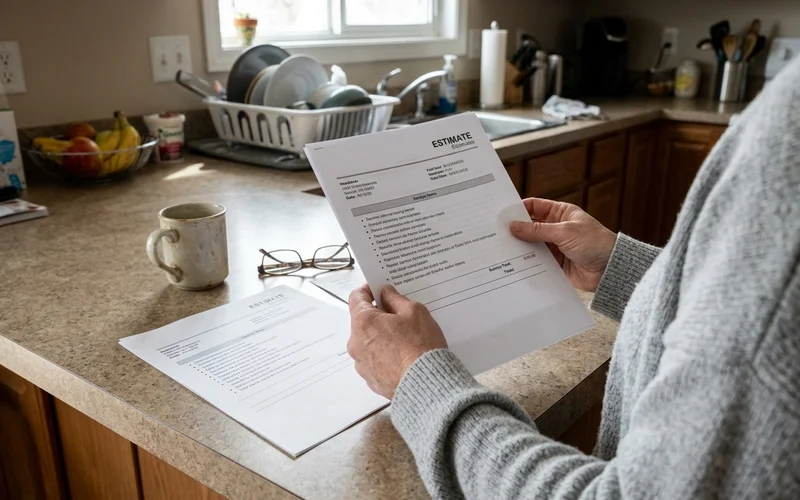
Near the Gulf and the bays, looking at the outdoor coil reveals the true condition of your unit. Flaking fins and a white crust mean the aluminum coil is losing efficiency and will likely start leaking.
We inspect dozens of these failing units weekly across coastal Alabama. Salt air causes rapid pitting on sensitive aluminum components.
If the coil is badly corroded, a repair elsewhere in the system simply buys you a few months before a catastrophic coil failure. Our standard procedure includes checking the coil condition thoroughly before quoting any major compressor work.
As seasoned coastal contractors note:
“A failing, salt-crusted coil forces the compressor to work twice as hard, accelerating the death of the entire cooling machine.”
5. How reliable does it need to be?
A full-time home can usually tolerate the occasional breakdown and a warm afternoon. A vacation rental absolutely cannot afford any downtime during peak summer season.
We understand the unique financial pressures faced by property investors in this area. For rental owners, every mid-season failure means issuing refunds, losing future bookings, and dealing with bad reviews.
Those negative reviews mentioning a broken AC cause long-term damage to your listing.
Our commercial clients factor this downtime as a real financial cost that belongs in the replacement math. Installing a reliable new system protects your rental income and your reputation.
Side-by-Side Comparison
Placing your options side-by-side clarifies the situation quickly. If most of your answers land in the right column, it is time to get replacement quotes.
We find this simple checklist helps homeowners cut through the confusion during a stressful breakdown. Use this chart to evaluate your current setup and figure out exactly when to replace ac units.
| Factor | Leans toward repair | Leans toward replacement |
|---|---|---|
| Age | Under 10 years old | Past 12 years (or 7 years beachfront) |
| Repair cost | Small relative to new system | About half of a new system or more |
| Refrigerant | R-410A or newer | R-22 (banned in 2020) |
| Coil condition | Clean, intact | Heavy salt corrosion, white crust, leaking |
| Repair history | First significant repair | Several major repairs in the last two years |
| Comfort | House stays comfortable and dry | Hot rooms, high humidity, short cycling |
| Use | Occasional use second home | Busy vacation rental or full-time home |
Other Things Worth Weighing
Beyond the immediate repair bill, you must consider long-term operating costs and comfort. Efficiency upgrades and proper sizing often provide enough monthly savings to offset the cost of a new unit.
Our team recommends weighing these four additional factors before making a final call.
- Efficiency: A new system at today’s SEER2 minimums will usually cost less to run than an older one. In 2026, the minimum for the Southeast region is 14.3 SEER2. The long coastal cooling season makes that difference bigger, saving money over 2,200 annual run hours.
- Humidity: If the house has always felt clammy, the old system may have been oversized. Replacement is a chance to size it properly and add variable-speed equipment that dries the air better.
- Timing: Replacing on your schedule, in spring or fall, is far easier than replacing in an August emergency. You want to avoid situations when contractors are booked solid.
- Warranty: A new system comes with fresh 10-year parts and labor warranties. An old unit has none left, leaving you exposed to future repair bills.
Three Common Gulf Coast Scenarios
Real decisions rarely fit neatly into a single mathematical rule. These situations represent the most common challenges seen across South Baldwin properties.
Our technicians use the exact logic described below to advise homeowners every day. Review these examples to see how the framework applies in practice.
The inland home with a failed capacitor
Consider a Foley brick ranch with a system that has been reliable and features a clean outdoor coil. The capacitor failed during a July heat wave, completely shutting down the cooling.
We consider this a very clear and obvious repair scenario. The replacement part is inexpensive, usually running between $150 and $300.
The rest of the system remains healthy, and there is no visible corrosion to worry about.
Our advice is to fix the issue immediately and book a preventative spring tune-up for next year.
The beachfront condo with a leaking coil
Imagine an Orange Beach condo located right on the Gulf side. The outdoor coil is crusted with salt, flaking rapidly, and the system has lost refrigerant twice in two summers.
Our crews find that a coil repair on an older coastal system is highly expensive and ignores corrosion elsewhere. This specific situation leans hard toward full replacement.
The smartest move involves a two-step upgrade plan:
- Install coastal-rated equipment built with factory epoxy coatings.
- Relocate the condenser to a protected area shielded from direct sea spray, pending HOA approval.
We suggest having your contractor verify the new placement meets local building codes.
The rental with an R-22 system and a slow leak
Look at a Gulf Shores rental house utilizing an outdated R-22 system. It still runs, but it needs a costly refrigerant top-off every single season because R-22 is scarce.
We strongly advise against pumping expensive, obsolete refrigerant into a leaking unit. Each top-off wastes money on a system that will never improve mechanically.
Every mid-season failure risks a lucrative vacation booking and creates unhappy guests.
Our property management clients know that a scheduled replacement in the off-season is the smart move.
What these have in common
The deciding factors in these scenarios were never just about the unit’s chronological age. They relied heavily on corrosion levels, refrigerant type, repeat failures, and the actual cost of downtime.
Our approach looks at the total cost of ownership rather than a single, isolated repair bill.
If you remain unsure about your specific situation, ask the contractor to walk you through these exact questions for your system.
When Repair Clearly Wins
Finding the right path forward is easy when the data lines up perfectly. Sometimes, fixing the current unit is undeniably the best financial choice.
We tell customers to proceed with a repair when they meet these specific criteria:
- The system is fairly young and the repair is a common part like a capacitor, contactor, fan motor, or drain issue.
- There is no significant salt corrosion on the outdoor condenser.
- It uses R-410A refrigerant and the charge is correct after a standard leak repair.
- It has historically kept the house comfortable and dry without running constantly.
In those cases, fix it and book regular maintenance to protect the investment.
See emergency AC repair for fast help when your unit unexpectedly quits.
Get Both Numbers
Making a massive financial decision between an ac repair vs replace requires having all the accurate data in front of you. Do not guess about the costs when professional estimates are readily available.
We connect you with a licensed, insured contractor already working in South Baldwin. Call (251) 270-2500 and ask for a repair estimate and a replacement quote.
Both quotes are completely free, and there is absolutely no referral fee.