
Why Salt Air Is Hard on Air Conditioners
If you own a home or condo near the beach in Gulf Shores, Orange Beach, Bon Secour or on Perdido Bay, your AC lives in salt air all year. Salt is one of the main reasons beach ACs wear out sooner than inland units. The good news is that regular cleaning makes a real difference. It is a core part of salt-air coil cleaning during maintenance visits.
Gulf breezes carry tiny salt particles that settle on everything, including the outdoor condenser coil. Salt attracts moisture from the humid air and forms a corrosive film. Over time it attacks:
- Aluminum fins, which get pitted, brittle and start to crumble
- Copper tubing, which can develop pinhole leaks
- Cabinet panels and screws, which rust
- Electrical terminals and wiring, which corrode and loosen
What Corrosion Looks Like
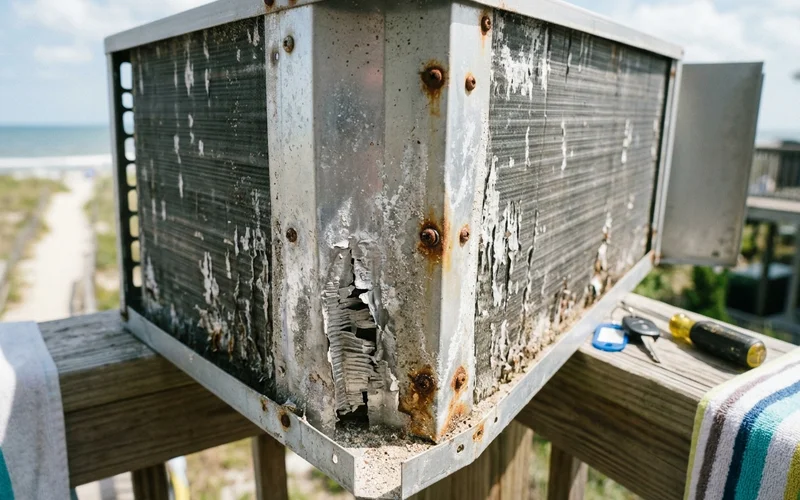
Walk out and look at your outdoor unit. Warning signs include:
| Sign | What it means |
|---|---|
| White, crusty or powdery buildup on the fins | Salt deposits; cleaning needed |
| Fins that crumble or flake when touched | Advanced corrosion |
| Green or dark spots on copper lines | Copper corrosion |
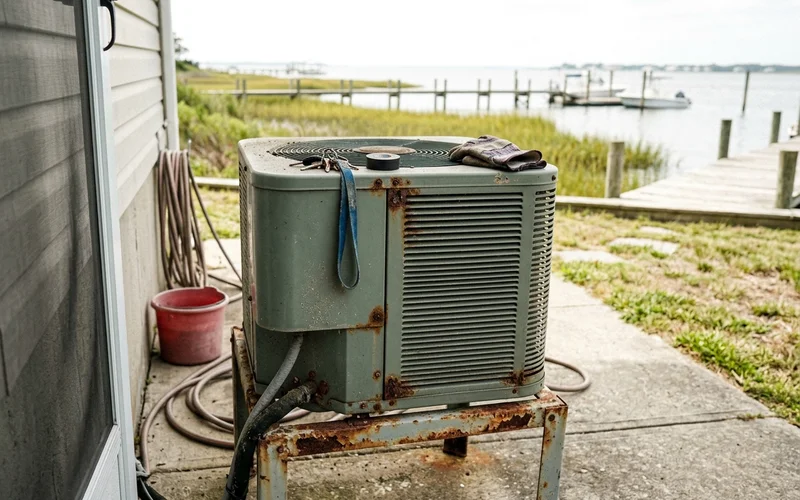
| Rust on the cabinet, base or screws | Cabinet deterioration |
| Rusted or wobbly condenser stand | Structural concern on raised homes |
| Oily spots on the coil | Possible refrigerant leak |
How Corrosion Hurts Performance
A corroded, salt-crusted coil cannot shed heat well. The unit runs longer and harder, pressures climb, and efficiency drops. Your power bill goes up while comfort goes down. Eventually, corroded tubes leak refrigerant, and the system starts blowing warm air. By then, the fix is often a new coil or a new system.
Beach AC Lifespan
There is no single number, but it is fair to say that beach units often wear out noticeably sooner than the same model a few miles inland. The biggest factors:
- Distance from the water. Beachfront and bayfront units take the worst of it.
- Exposure. A unit facing the Gulf wind corrodes faster than one sheltered by the house.
- Equipment. Coastal-rated units with coated coils hold up longer. See coastal-rated AC condensers.
- Maintenance. Regular cleaning is the one factor you fully control.
Fresh-Water Rinses You Can Do
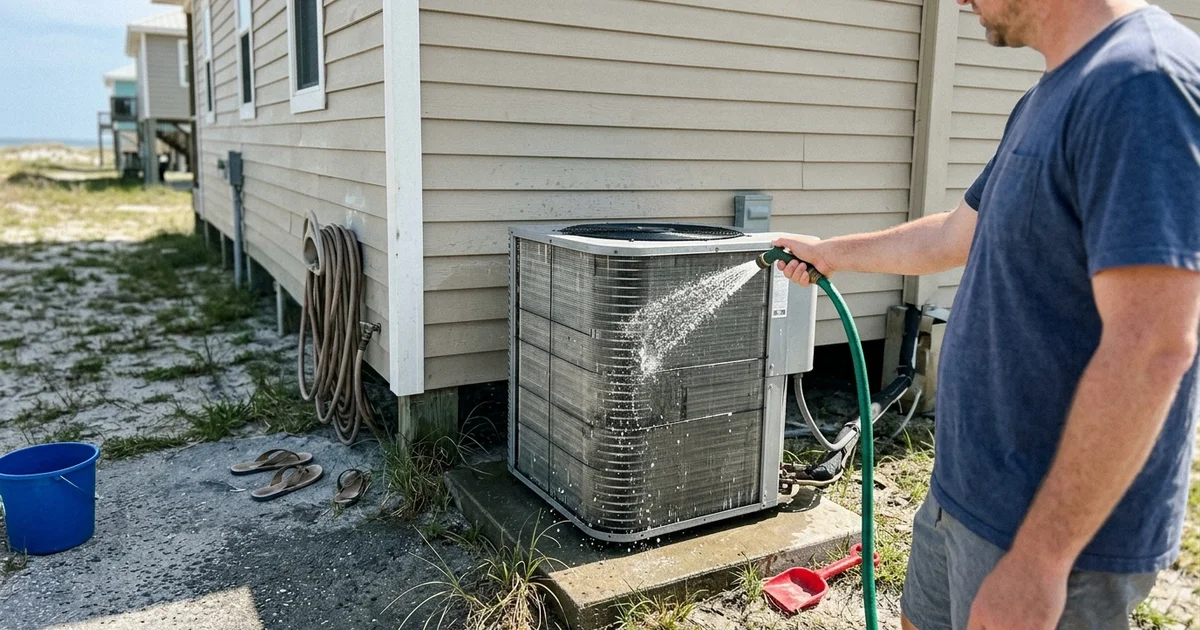
A gentle rinse with fresh water washes salt off before it builds up. For units near the beach, every few weeks during the season is a good habit.
- Turn off power at the outdoor disconnect and at the thermostat.
- Clear debris like leaves and grass from around the unit.
- Rinse gently with a garden hose on a soft spray setting. Work from the top down.
- Do not use a pressure washer. High pressure bends the fins flat and can strip protective coatings.
- Do not use harsh chemicals unless they are made for AC coils.
- Let it dry a few minutes, then restore power.
Keep it gentle
The fins on an AC coil are thin and bend easily. A light shower of fresh water is all you need. If fins are already bent flat, a contractor can straighten them with a fin comb.
Professional Coil Cleaning
A contractor goes further than a rinse. A professional cleaning usually includes:
- Removing the top panel and fan to clean from the inside out
- Applying a coil cleaner made for the job, then rinsing thoroughly
- Straightening bent fins
- Checking for refrigerant leaks and corrosion on copper lines
- Inspecting electrical terminals and tightening connections
- Checking the stand, pad and mounting hardware
For most beach properties, once a year is the minimum. Units right on the water, rooftop condo units and busy rentals often benefit from twice a year.
How Often to Inspect
- Beachfront and bayfront: professional cleaning at least yearly, rinses every few weeks in season
- Within a few miles of the water: yearly cleaning, occasional rinses
- Inland Foley and Summerdale: standard yearly tune-up, rinse after storms or heavy pollen
After any tropical storm or strong onshore wind, rinse the unit once it is safe to do so.
Protecting Your Next System
When it is time to replace, consider a coastal-rated unit, place it out of direct spray if possible, and ask about coil coatings. Pair that with regular cleaning.
Call (251) 270-2500 to book salt-air coil cleaning with a licensed, insured contractor who works along the beach every week. The estimate is free, and there is no referral fee.