
What Short Cycling Is
We often get calls from South Baldwin homeowners complaining about ac short cycling and a house that never quite feels comfortable. According to the US Department of Energy, a healthy AC system should run for a solid 15 to 20 minutes per cycle.
Short cycling units shut off in under 10 minutes, completely breaking that natural cooling rhythm.
Our technicians consider this rapid cycling a serious threat to your expensive equipment. Sudden changes in how your system runs might mean you need immediate AC repair. The following guide breaks down the main causes and exactly what you can do about them.
Why It Matters So Much in a Coastal Home
Our coastal climate makes indoor humidity control an absolute necessity. The Environmental Protection Agency explicitly warns that indoor humidity above 60 percent becomes a breeding ground for mold.
We see the consequences of ac short cycling during the first few minutes of every cooling cycle. An air conditioner mostly just cools the indoor coil when it first starts up.
We recommend reading our complete guide on why a house is humid with the AC on to understand this dynamic deeper.
Short cycling also drains your wallet in a few specific ways:
- Compressor wear: Starting is the hardest moment for a compressor, and excessive starts dramatically shorten its lifespan.
- Higher energy bills: Energy Star data reveals that starting an AC requires significantly more power than running it continuously.
- Electrical stress: Capacitors and contactors wear out much faster with constant voltage surges.
The Common Causes
An oversized unit
We find that an oversized air conditioner is the most common long-term cause of short cycling. A system that is too large for the house cools the air so fast that the thermostat is satisfied in mere minutes.
The equipment shuts off long before it has removed enough moisture from the air. Our team frequently sees homes with oversized AC units because an installer used a quick square-foot guess instead of proper math.
The national standard for sizing residential equipment is an ACCA Manual J load calculation, which accounts for windows, insulation, and sun exposure. Addressing oversized ac humidity issues requires these precise measurements to ensure proper dehumidification. We suggest checking out what size AC you need for a humid coastal home for a breakdown of these calculations.
Thermostat placement
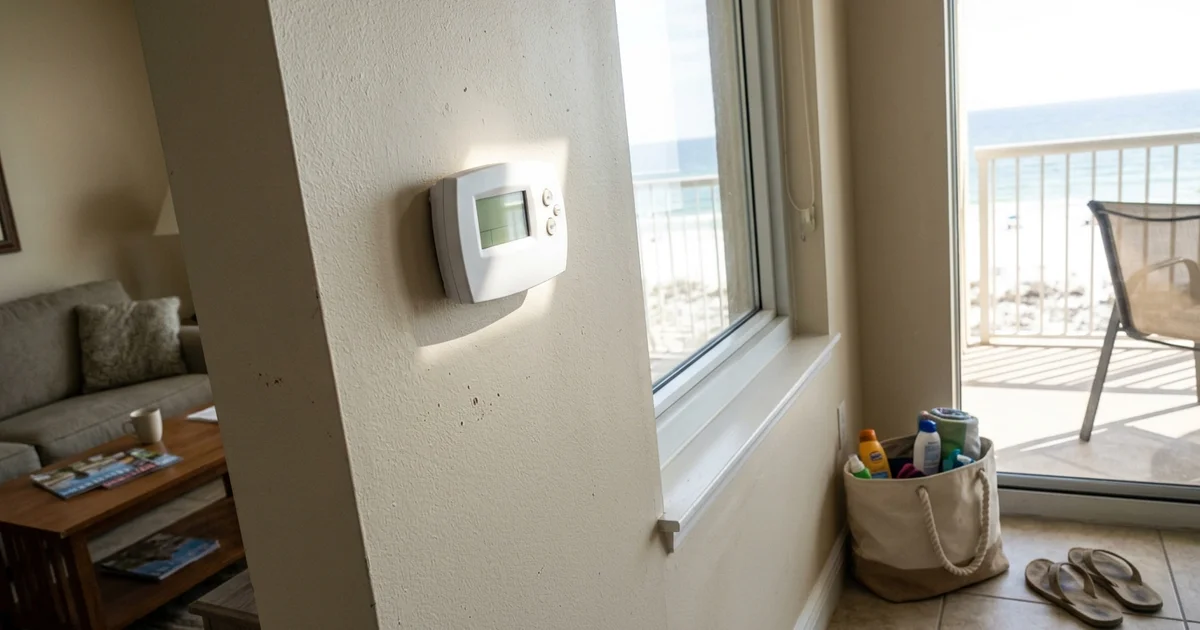
A thermostat in direct afternoon sun, next to a supply vent, or near a lamp reads the wrong temperature entirely. We see this flaw constantly in beach condos with thermostats mounted on walls facing large Gulf windows.
The direct sunlight heats the thermostat casing, causing it to read several degrees higher than the actual room temperature. This false reading either shuts the system off prematurely or results in the ac cycling too often.
Our recommendation for this specific issue is to upgrade to a smart thermostat. Devices from brands like Ecobee or Nest offer remote room sensors that average the temperature across the entire home. This simple technology permanently solves the problem.
Low refrigerant
We always check for refrigerant leaks when a system struggles to maintain a consistent cycle. A leak in your R-410A or R-454B refrigerant lines drops the internal pressure significantly.
This pressure drop trips a low-pressure safety switch, which immediately cuts power to the compressor to prevent catastrophic failure.
Our technicians know that once the pressure temporarily recovers, the compressor tries to start again. The cycle repeats endlessly until the leak is located and professionally repaired.
Electrical faults
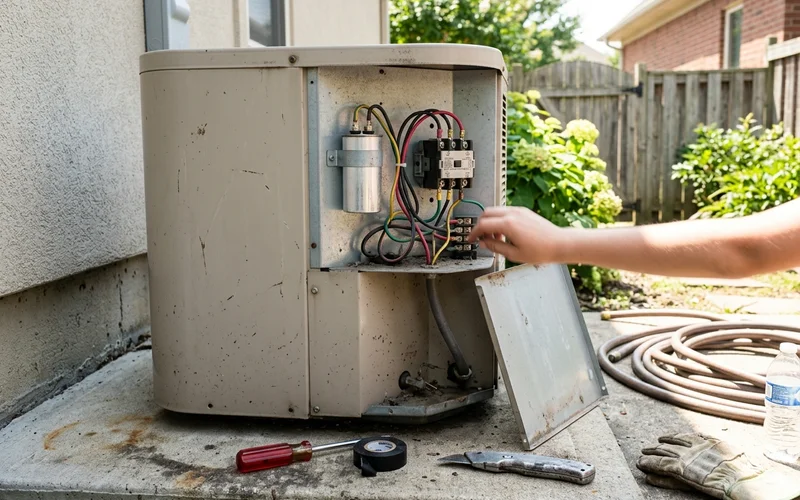
A failing capacitor, a pitted contactor, or a loose wire can force the outdoor unit to start and stop rapidly. We frequently replace dual-run capacitors that have lost their necessary microfarad rating.
The compressor requires a massive surge of power to start, drawing Locked Rotor Amps that can hit 6,000 to 9,000 watts for a standard 3-ton unit. A weak capacitor simply cannot deliver that vital electrical jolt.
Our repair crews also look for compressors that have overheated and tripped their internal thermal overload switch. The unit shuts down to protect itself and then restarts once the metal cools off.
Airflow problems
We constantly battle airflow restrictions caused by clogged air filters or dirty evaporator coils. Reduced airflow causes the indoor coil to drop below freezing, which eventually trips a safety control.
Coastal environments present a unique challenge for the outdoor condenser coil. Our area sees heavy salt and sand buildup that coats the outdoor fins in a restrictive biofilm.
The US Department of Energy notes that a neglected, dirty coil can increase energy consumption by 15 percent. This blockage makes internal pressures climb until a high-pressure switch shuts the whole system down.
What You Can Check
We encourage homeowners to perform a few basic checks before picking up the phone. Keep in mind that you should never open the outdoor unit’s electrical panel.
Capacitors hold a highly dangerous 240-volt charge long after the power is turned off. Our team suggests inspecting the following safe areas:
- Air filter: Replace the filter immediately if it appears dark or restricted.
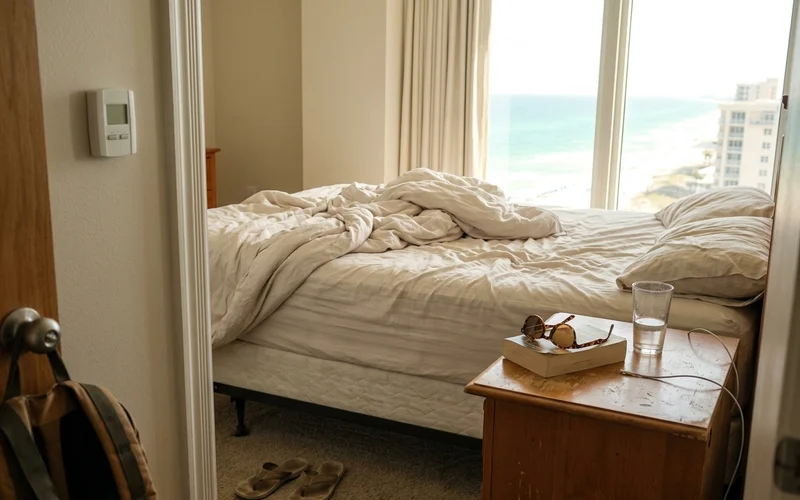
- Thermostat location: Check if the thermostat sits in direct sunlight or near a heat source. Try closing the blinds to see if the cycling frequency improves.
- Thermostat settings: Verify that the fan setting is on AUTO instead of ON. Leaving it ON blows evaporated moisture back into the house.
- Outdoor unit: Clear away any leaves, tall grass, or stored items stacked against the condenser.
Repair or Resize?
| Cause | Typical fix |
|---|---|
| Failing capacitor or contactor | Replace the part (adding a hard start kit can also reduce startup surge by 30 to 50 percent) |
| Low refrigerant | Find and repair the leak, then recharge |
| Thermostat in a bad spot | Relocate the thermostat, shield it, or use remote sensors |
| Dirty coil or filter | Clean the coil, replace the filter |
| Oversized system | Adjust blower speed, add dehumidification, or right-size at replacement |
We evaluate the age and condition of the equipment before recommending a massive overhaul. If an oversized system is fairly new, a contractor can often reduce the problem by adjusting the blower speed.
Installing a whole-home dehumidifier is another excellent way to handle excess moisture without replacing the AC.
Our preferred long-term solution for older equipment is installing a correctly sized, variable-speed system. Modern SEER2 variable-speed compressors run continuously at lower speeds, which fixes the humidity problem at its root.
Get It Checked
We are ready to help if your ac turns on and off frequently in Foley, Gulf Shores, Orange Beach, or anywhere in South Baldwin. Call (251) 270-2500 to connect with a licensed, insured contractor who serves your specific area.
The assigned professional will diagnose the precise cause of the short cycling.
Our service ensures you receive a free estimate before any work begins, and there is never a referral fee. Reaching out today can save your compressor from completely failing tomorrow.